
Agents that know your business.
Generic chat tools do not know your products, your policies or your customers. We build assistants that answer from your own documents with citations, and agents that complete multi-step work across your systems, with a person approving the steps that matter. Every build ships with an evaluation set and monitoring, the same way we run the multi-agent platform behind ATR Drill's sales pipeline.
- RAG
- Agents
- Evals
Ask me anything. I answer from your docs, with sources.
Yes. Unopened bulk orders can be refunded within 30 days 1, and A-1042 was delivered nine days ago, still sealed 2.
Bulk orders may be refunded within 30 days if unopened.
Delivered 3 Oct. 60 units, seal intact.
Personalised items are final sale.
- Policies and guidessynced
- Order systemsynced
- CRM accountssynced
Custom AI and agents at a glance
- What it is
- AI assistants that answer from your own documents, and agents that complete multi-step work in your systems.
- Who it is for
- Businesses with a lot of internal knowledge, repetitive questions or document-heavy work.
- Price
- Quoted per project after a call. Model usage is billed by the provider, and we estimate it before you start.
- Time
- A working test on your own data first, then the live build. Dates are in the quote.
- Where
- For clients across India, the UAE, Oman and Saudi Arabia, from our team in Maharashtra.
AI that answers from your own data.
Answers with sources
Assistants cite the document and section they used, so people can check an answer rather than trust it blindly.
Agents with limits
Defined tools, permissions and approval steps, so an agent acts only where it is allowed to.
Quality you can measure
An evaluation set built from real questions, run before every change and tracked in production.
Built on what your business already knows.

Custom AI means systems built around one company's knowledge and processes rather than a general chat tool. Retrieval-augmented generation, or RAG, finds the relevant passages in your own documents and hands them to a model such as Claude or GPT to answer from, with citations. Agents go further: given a goal and a set of tools, they plan the steps, call your systems and finish the task.
The real work is in what surrounds the model. We decide what data the system may use and who may see it, design the tools an agent can call, set the points where a person must approve, and build an evaluation set from real cases before launch. The ATR Platform is built this way: a lead scraper, an outreach agent that classifies replies, and a handoff agent that briefs a sales rep on WhatsApp the moment a lead turns hot.
What custom AI can do for you.
RAG knowledge assistants
Answers across your documents, wikis, tickets and product data, with citations and access rules that match your team's permissions.
Multi-agent systems
Specialised agents that each own one job and hand work to each other, like the lead, outreach and handoff agents we run for ATR Drill.
Agents inside your tools
Agents that read and write to your CRM, inbox, database and internal apps through APIs and MCP, not just a chat window.
Document processing
Extraction and classification for contracts, invoices, forms and emails, with confidence checks and a queue for human review.
Human in the loop
Approval steps, escalation rules and review screens, so people stay in charge of the decisions that carry risk.
Evals and monitoring
Test sets, automated and human grading, tracing and cost tracking, so quality is measured instead of assumed.
Built and running
Systems in production today.
Not concepts. These run every day, for clients and for our own studio. The screens are the real ones, with client details blurred.
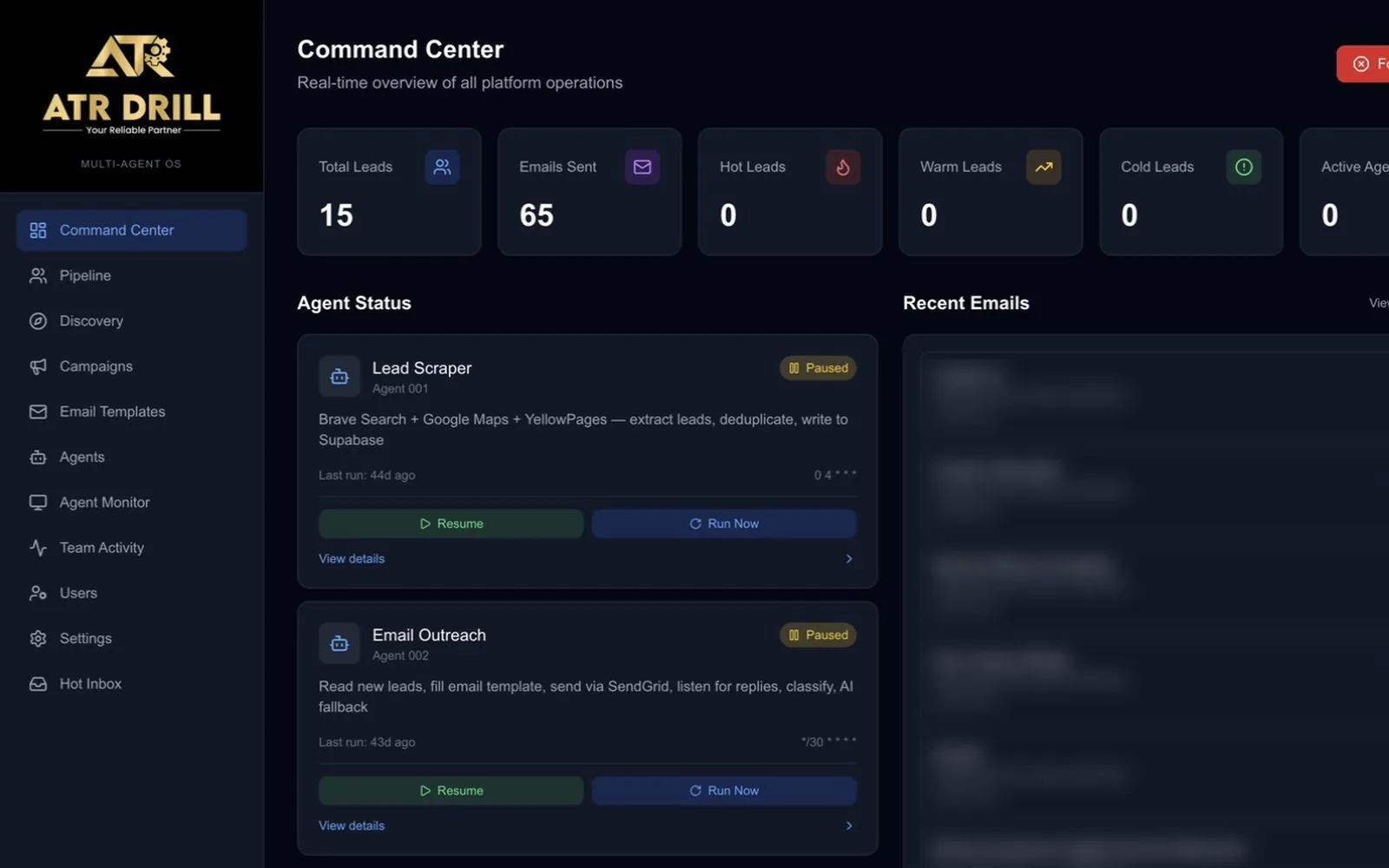
ATR Platform, Multi-Agent OS
ATR Drill, Dubai
A command centre running three agents: a lead scraper that pulls prospects from search and maps into Supabase, an email outreach agent that sends, listens for replies and classifies them, and a sales handoff agent that briefs a rep on WhatsApp the moment a lead turns hot.
Next.jsSupabaseSendGridClaudeWhatsApp
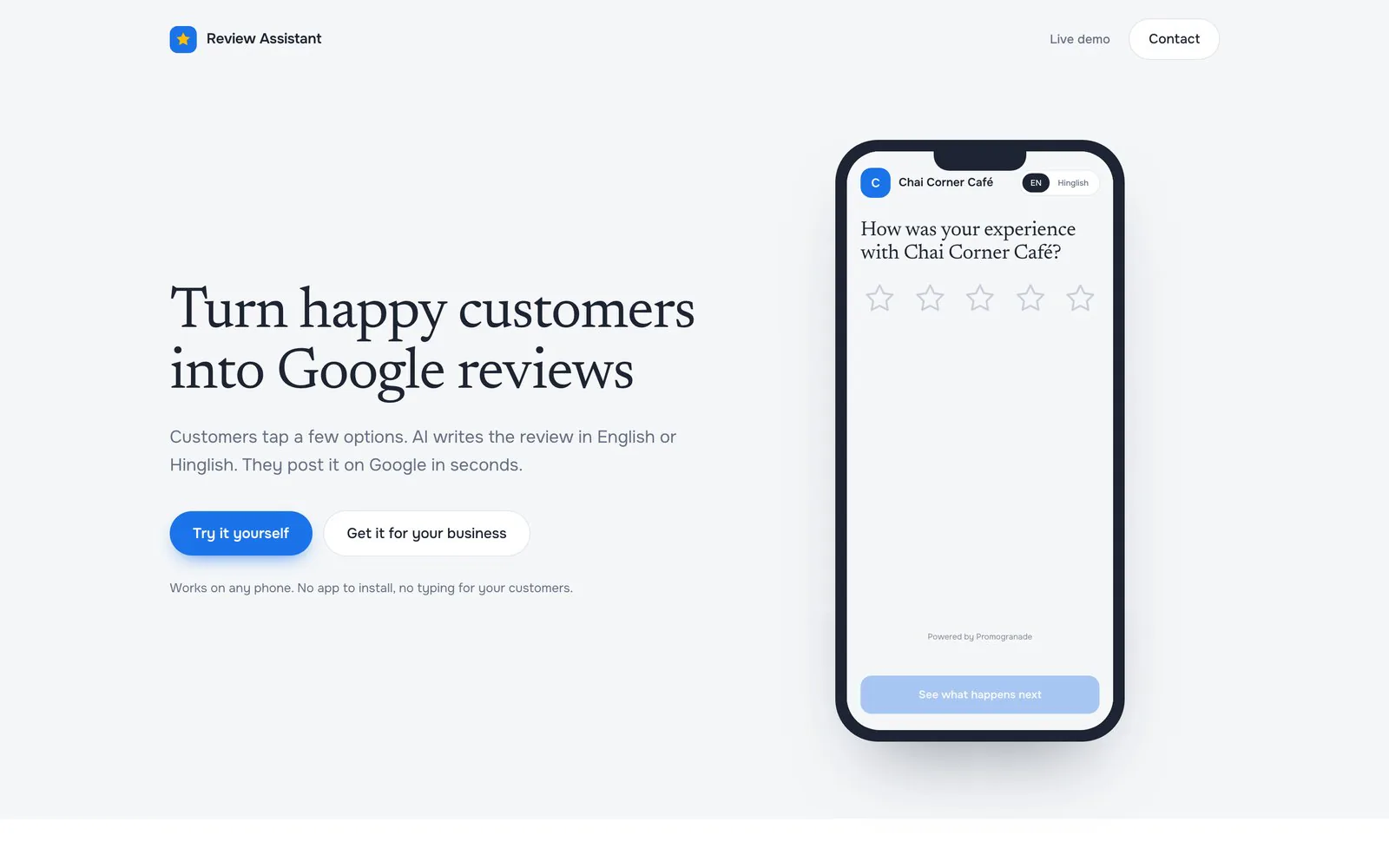
Review Assistant
Food Mitra, Jalgaon, and other local businesses
Turns happy customers into Google reviews: a printed QR sticker opens the business's review page, the customer taps a rating, AI drafts the review in English or Hinglish from the business's own services and highlights, and they copy it straight to Google. Owners manage each business, its QR and the analytics from one admin.
Next.jsAI draftingGoogle Business ProfileVercel
See the live product page
How we build an AI assistant.
Stack we reach for
 Claude
 OpenAI
 LangChain
 LangGraph
- LSLangSmith
- pgvpgvector
 Python
Custom AI and agents, explained.

A RAG system has two halves. The first prepares your knowledge: documents are split into passages, each passage is turned into an embedding, a numeric representation of its meaning, and stored in a vector database with its source and access rules. The second answers questions: it finds the passages closest in meaning to the question, often combined with ordinary keyword search, and passes them to the model with instructions to answer only from them and cite where each claim came from. Most quality problems trace back to the first half, in how documents are cleaned, split and labelled.
An agent is a model working in a loop. It receives a goal, decides which tool to call, reads the result and chooses the next step, until the task is done or it needs help. Frameworks such as LangChain and LangGraph structure that loop, keep state between steps and let several specialised agents hand work to each other. The Model Context Protocol, or MCP, gives agents a standard way to connect to tools and data. The more an agent is allowed to do, the more its permissions, approval steps and fallbacks matter.
Evaluation is what turns a promising demo into a system a business can rely on. An eval set is a collection of real inputs with known good outputs or clear grading rules. Running it before each change shows whether a new prompt, model or retrieval setting made things better or worse. In production, tracing records every step an agent took, what it cost and where it failed, and human feedback flags the answers that were wrong. Choosing between Claude, an OpenAI model or a smaller open model then becomes a decision based on measured accuracy, speed and cost rather than preference.
Custom AI and agents: questions
Common questions about custom AI and agents.
Anything else, ask us on WhatsApp or by email.
Business API access from Anthropic and OpenAI does not use your data for training by default. We also control what each system can see, keep access rules on every document, and can host components in your own cloud when required.
Guides on custom AI and agents.

AI and automation
How AI agents work: a goal, tools, memory and a loop of checks.
An AI agent is a language model given a goal, a set of tools and a loop to work in. Here is how the parts fit together, when a simpler workflow is better, and what a real one looks like.
30 October 2026Read

AI and automation
What is RAG? How AI can answer from your own documents.
RAG lets an AI model answer from your own documents and show where each answer came from. Here is how it works, and when a simpler option is the better choice.
30 October 2026Read

AI and automation
AI agents for a growing business: start with one job, not a platform.
Agents can now reach the tools a business actually uses. The ones that pay off start small: one clear job, real data, human approval where it matters and a way to see what they did.
15 October 2026Read
Other AI and automation services.
Also from the same team
Want an assistant that knows your business?
Tell us what you need and roughly when. We will come back with questions or a time to talk.