
Web projectsBy Naman Agarwal · 17 October 2026 · 5 min read
How to make a website for your business: plan, build, launch.
The platform matters less than people think. What decides whether a business website works is the planning before the build and the checks before launch. Here is the whole process.

To make a website for your business, decide what the site must achieve, plan its pages around the questions your customers ask, choose a platform that fits (WordPress for content-led sites, Shopify for online stores, a framework such as Next.js for bespoke experiences), write the content, build it fast and mobile-first, set up the SEO basics and test everything before launch. The platform matters less than the planning and the content.
What should I decide before building a website?
Most website problems start before anyone opens a design tool. A short written plan saves weeks of rework later.
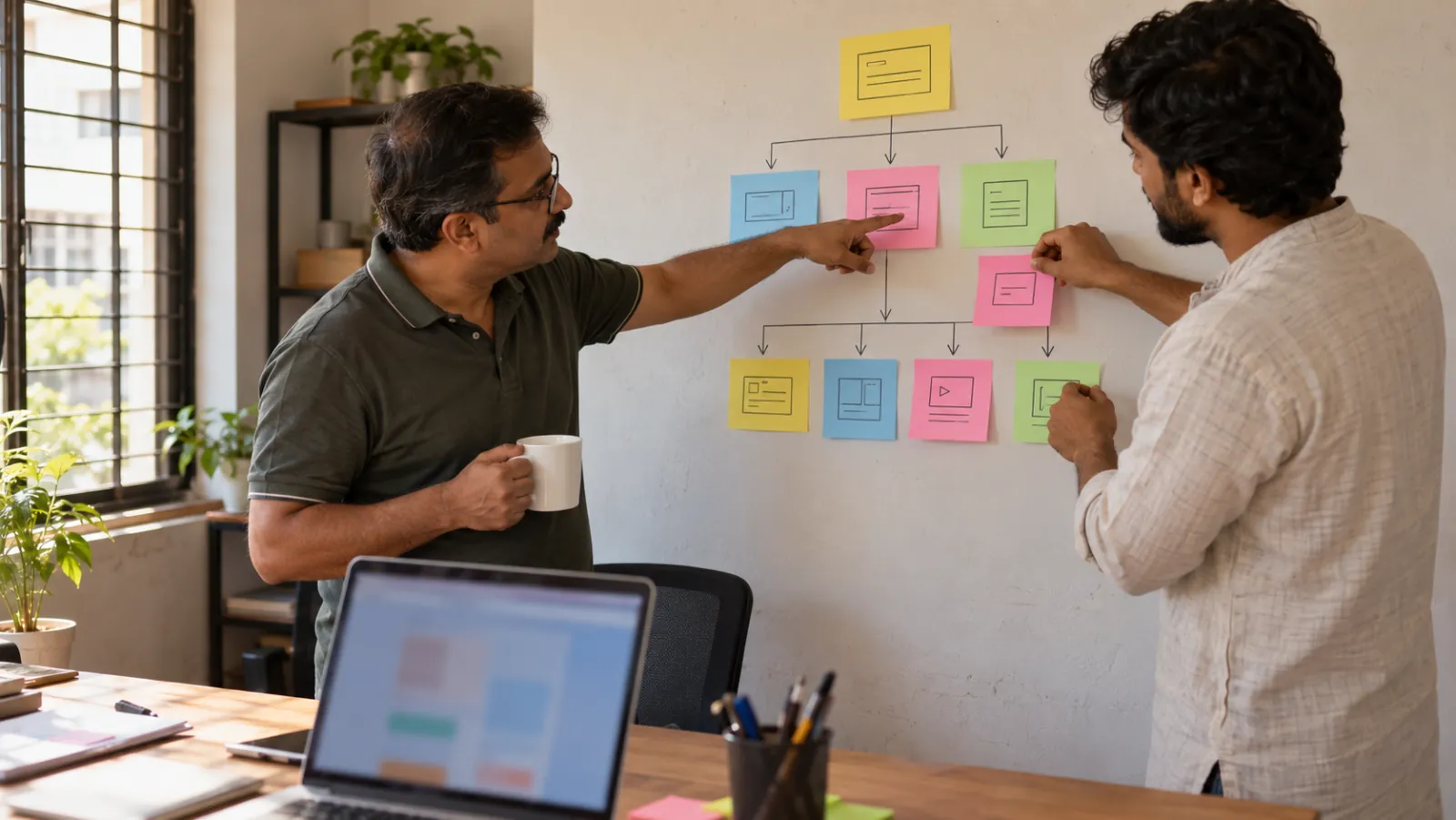
- The goal: enquiries, bookings, online sales or credibility for people who already know you. Pick one main goal.
- The audience: who visits, what they need to know before they act, and what device they are likely to use.
- The one action you want visitors to take, such as call, message on WhatsApp, book or buy.
- The pages: list them, and write one sentence on what each page is for.
- Who will update it: a content team that publishes every week needs different tools from a site that changes twice a year.
- Your brand: settle the logo, colours and type first. Our guide on how to build a brand covers this.
Which platform should I use: WordPress, Shopify or Next.js?
Choose the platform that fits the team and the job, not the one that is fashionable. Each is a good answer to a different question.
- WordPress suits content-led sites where a team publishes often and wants to edit pages without a developer. Keep plugins few and well maintained.
- Shopify suits businesses that sell products online. Checkout, payments, stock and shipping come built in, and apps cover most extras.
- Next.js and similar frameworks suit bespoke experiences, high performance targets and sites that connect to other systems. They need a developer to change structure.
- Hosted site builders can work for a very simple site you will manage yourself, but check what you can export if you ever want to move.
If the site needs logins, customer portals or workflows unique to your business, it is closer to an application than a website. That is where custom software comes in.
What pages does a business website need?
- A home page that says what you do, for whom, and what to do next, within the first screen.
- One page per service or product line, each answering the questions a buyer asks about it.
- Proof: examples of your work, case studies or reviews, with real names where clients agree.
- An about page that shows the people behind the business.
- A contact page with every way to reach you, your service area and your hours.
- Legal pages: privacy policy and, if you sell online, terms, returns and shipping.
How do I write website content that ranks and converts?
Write for people first. Google's guidance on helpful content asks whether a page exists mainly to help the visitor, and suggests making clear who created it, how and why. Of the qualities it describes as experience, expertise, authoritativeness and trust, it says trust matters most. In practice that means specific, checkable information: what you offer, what it costs or what changes the price, how long it takes, where you work and who is behind it.
Answer the main question of each page in its first sentences, then add detail. Use the words your customers use, which you can find in enquiries, sales calls and Search Console. Pages written this way are also the ones AI answers tend to quote, which is the focus of our SEO, GEO and AEO service.
How fast does a business website need to be?
Fast enough to pass Google's Core Web Vitals for real visitors. web.dev sets the good thresholds as a Largest Contentful Paint of 2.5 seconds or less for loading, an Interaction to Next Paint of 200 milliseconds or less for responsiveness, and a Cumulative Layout Shift of 0.1 or less for visual stability, each measured at the 75th percentile of visits on mobile and desktop. We explain the responsiveness score in INP: the speed score that measures whether your site feels broken.

Design for phones first. Google uses the mobile version of a site for indexing and ranking, so the mobile pages need the same content, headings, structured data and metadata as the desktop ones. Hiding content on mobile can cost you traffic.
What are the SEO basics for a new website?
- A unique, descriptive title and meta description for every page.
- Readable URLs that use words, not random strings of characters.
- One clear main heading per page, with logical subheadings below it.
- Descriptive alt text on meaningful images, and images compressed for the web.
- Internal links between related pages, with link text that says where it goes.
- An XML sitemap, submitted in Search Console or listed in robots.txt.
- Structured data that matches what is visible on the page, such as your organisation details.
- Redirects from old URLs to new ones if you are replacing an existing site.
Google's SEO Starter Guide confirms it does not use the keywords meta tag, so there is no need to fill one in. Aim for accessibility too: WCAG 2.2 at level AA is the current reference standard, and accessible sites tend to be easier for everyone to use.
How much does a business website cost?
It depends on scope far more than on platform, which is why honest quotes come after a scoping conversation rather than before. These are the things that move the price most.
- The number of unique page templates. Ten pages built from three templates cost less than ten different layouts.
- Who writes the content and sources the images. Content is often the longest part of a project.
- E-commerce scope: the size of the catalogue, product options, payment methods and shipping rules.
- Integrations with CRMs, booking systems, inventory or accounting software.
- Custom features such as calculators, portals, search or multilingual content.
- Running costs: hosting, domain, paid themes, plugins or apps, and ongoing maintenance.
Website launch checklist
- Test every form and contact link, and confirm the messages arrive where they should.
- Check every page on a real mid-range phone, not only on a desktop browser.
- Run PageSpeed Insights on key templates and fix any red results.
- Confirm analytics and conversion tracking record the actions that matter.
- Check that pages are allowed to be indexed, then submit the sitemap in Search Console.
- Set up redirects from old URLs and test a sample of them.
- Update your Google Business Profile and social profiles with the new address.
- Book a review a month after launch to fix what real visitors reveal.
In short: plan the goal and the pages first, pick the platform that fits your team, write content that answers real questions, build for phones and speed, and check the basics before launch. You can try the sites we have built on our work page. If you are planning a new site or a rebuild, our web projects service covers the whole process, and you can tell us what you need.
Sources
Related services
Want this done for you?
Web projects for businesses in India and the UAE.
More from the blog
- WebsitesApple's first touchscreen MacBook: what it means for your website, and should your business buy one?Read the post
- Web projectsNext.js vs WordPress: an honest comparison for a business website.Read the post
- Web projectsShopify vs custom e-commerce: when to stay, when to build, and the middle path.Read the post